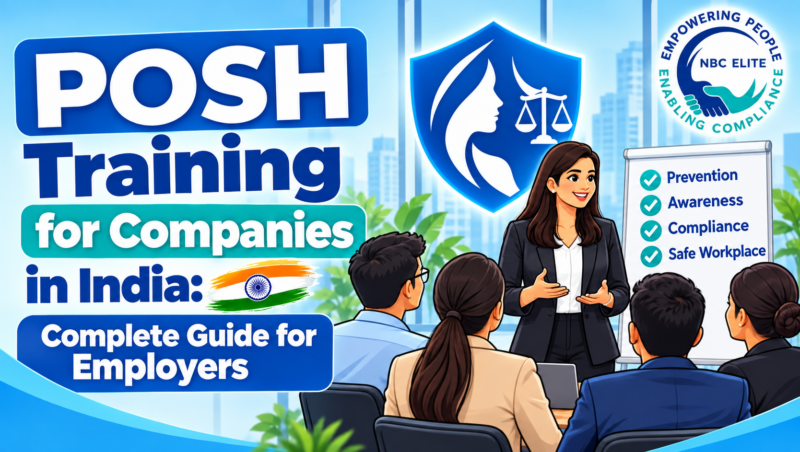
POSH Training for Companies in India: Complete Guide for Employers
Having a policy on POSH in the HR folder is not enough to create a safe workplace.
It happens when staff are aware of the inappropriate behaviors in the workplace, managers are aware of their duties, members of the Internal Committee know how to respond to a complaint and leadership is in place to ensure that concerns are made without fear.
That is why POSH training for companies in India is an important aspect of workplace compliance and prevention.
The employer is responsible for organizing workshops and awareness programs on a regular basis as mandated by the Sexual Harassment of Women at Workplace (Prevention, Prohibition and Redressal) Act, 2013, to make the employees aware of the provisions of the Act. The law also requires orientation programmes for members of the Internal Committee.
For employers, the question is therefore not simply, “Do we have a POSH policy?”
The more important questions are:
- Do employees know what the policy is?
- Does everyone know how and where to report a complaint?
- Are the Internal Committee constitution and trained correctly?
- Do managers have the capability to respond appropriately?
- Are training and compliance records maintained?
- Is POSH awareness conducted regularly rather than as a one-time activity?
This comprehensive guide details the approach that companies in India can take with respect to POSH training, the requirements of the law, who should be trained, what a good programme should include and how employers can establish a realistic POSH compliance framework.
What Is POSH Training?
POSH training refers to awareness, sensitisation and orientation programmes for workplaces conducted in the context of the Indian law for the prevention, prohibition and redressal of sexual harassment at the workplace,
POSH stands for Prevention of Sexual Harassment.
A good corporate training programme for the Position of Safeguarding Children (POSH) will usually include training for employees that focuses on:
- What constitutes sexual harassment
- What behaviours may create a hostile or offensive work environment
- Employees’ rights and responsibilities
- The company’s POSH policy
- How to report a concern or complaint
- The role of the Internal Committee (IC)
- The complaint and inquiry process
- Confidentiality requirements
- Protection against retaliation
- Appropriate workplace behaviour
- The responsibilities of managers and leadership
Some of the legislation and resources published in the Ministry of Women and Child Development includes the POSH Act, POSH Rules and official handbook.
Is POSH Training Mandatory for Companies in India?
Yes, the employers have a specific training and awareness duty under the POSH Act.
Section 19(c) requires employers to organise workshops and awareness programmes at regular intervals for sensitising employees to the provisions of the Act and to organise orientation programmes for Internal Committee members.
Important is the fact that the Act does not contain a statutory formula that every employee is to be provided with at least one session each year.
It is therefore advisable for companies to not offer “annual training” as the exact number of times laid out in the Act.
Many organisations however, use an annual refresher programme plus a POSH training when onboarding as a practical compliance method. The training calendar should be tailored to the workforce, locations, and policy and compliance guidance of the organisation.
Who Needs POSH Training?
It is important to realize a strong POSH programme should not only be HR or women employees.
The awareness level of various groups is different.
1. All Employees
General employee POSH training should provide an explanation of:
- Understanding what sexual harassment is under the law.
- Examples of inappropriate conduct
- Workplace boundaries
- How to report concerns
- Available complaint mechanisms
- The role of the Internal Committee
- Confidentiality
- Protection against retaliation
- The company’s POSH policy
The aim is to inform their employees of their rights and duties.
2. Managers and Team Leaders
When employees have a problem, they are likely the first to turn to the manager.
The manager led training on POSH should include:
- How to respond when an employee raises a concern
- What managers should and should not investigate themselves
- When to escalate a matter
- How to avoid victim-blaming
- Maintaining confidentiality
- Preventing retaliation
- Supporting staff during the formal process while maintaining the integrity of that process.
3. Internal Committee Members
The orientation and training of the members of the Internal Committee are needed.
The Internal Committee, which includes a Presiding Officer, a senior level female employee, at least two employee members and at least one external member as specified by the POSH Act, must be at least 50% female.
IC training should not simply be training in general employee awareness.
It can cover:
- Jurisdiction of the committee
- Complaint intake
- Preliminary procedural considerations
- Principles of natural justice
- Conducting an inquiry
- Evidence and documentation
- Witness handling
- Confidentiality
- Interim relief
- Inquiry timelines
- Report writing
- Recommendations
- Record management
- Avoiding conflicts of interest
The Act mandates a 90-day inquiry, subject to the provisions of the Act.
4. Senior Leadership and HR
Organisation responsibility should be the basis of leadership training.
Topics can include:
- Employer responsibilities
- Governance and oversight
- POSH policy implementation
- Internal Committee support
- Training and awareness
- Documentation
- Reporting obligations
- Workplace culture
- Responding appropriately to complaints
What Does the POSH Act Require From Employers?
POSH training needs to be incorporated into a compliance programme.
The Act lists a number of duties for employers in section 19, such as:
- To ensure a safe working environment.
- The penalties for sexual harassment will be showcased.
- Displaying the order constituting the Internal Committee
- Organizing workshops and awareness programmes on a periodic basis.
- Conducting orientation programmes for Internal Committee members
- Supporting the Internal Committee with facilities and support
- Helping with attendance of respondents and witnesses
- Providing information required by the committee
- Supporting an aggrieved woman if she chooses to make a police complaint
- Taking appropriate action where required
- Treating sexual harassment as misconduct under applicable service rules
- Track and review the delivery of Internal Committee reports at the right time
It is important to realise that POSH compliance is not a one-off training session.
It is a continuous responsibility of the organisation.
What Should a Corporate POSH Training Programme Cover?
A good POSH training programme needs to be a mix of legal awareness, and realistic situations.
1: Understanding POSH
Employees should understand:
- Meaning of POSH
- What is the purpose of the POSH Act?
- Why workplace prevention matters
- Scope of the law
- Key terminology
2: What Constitutes Sexual Harassment?
Training should clarify examples of behaviour that could be considered within the definition and reference to workplace examples.
Depending on the audience, scenarios may include:
- Unwelcome physical contact
- Sexual remarks or comments
- Requests for sexual favours
- Sexually coloured remarks
- Unwelcome communication
- Inappropriate messages or digital communication
- Display of sexually explicit material
- Conduct creating an intimidating, offensive or hostile work environment
What you want is not to be frightened or scared, but to be educated.
All staff members should be aware of the difference between appropriate and inappropriate interactions taking place at work, and those that may extend beyond legal or organisational limits.
3: Workplace Examples and Scenarios
Training on POSH can be made easier to understand with the use of scenario based learning.
For example:
Scenario: A manager is repeatedly contacting an employee late in the night with personal messages when the employee has indicated the communication is unwanted.
Training can discuss:
- Why context matters
- What constitutes unwelcome behaviour
- How the employee can seek assistance
- What the manager should do
- How the organisation’s reporting mechanism works
4: Digital and Remote Workplaces
Modern POSH programmes should also discuss workplace interactions by:
- Messaging applications
- Video meetings
- Workplace collaboration platforms
- Social media interactions connected to work
- Virtual events
- Business travel
- Off-site meetings and events
As the definition of workplace is not confined to the conventional office desk, organisations should make clear workplace behaviour in the context of the work environment.
5: Reporting Mechanism
All staff need to be aware:
Where do I go if I experience or witness inappropriate conduct?
Training should be clearly designed to make it clear to the learner:
- Who the Internal Committee members are
- How to contact them
- What information can be provided
- What the complaint process involves
- What confidentiality means
- What support mechanisms are available
Companies need to make sure that information provided as part of training is aligned with the company’s true POSH policy and reporting procedure.
6: Role of the Internal Committee
It is important for employees to realize that the Internal Committee is not just an HR grievance committee.
The committee has a clear statutory duty to respond to complaints in relation to the POSH framework.
Training should explain:
- Who serves on the committee
- What the committee does
- How complaints are handled
- What confidentiality means
- What employees can expect from the process
7: Confidentiality
One key element of compliance with the POSH policy is confidentiality.
The Act places restrictions on publication or the communication of the contents of complaints and inquiries proceedings, the identity of the parties and of witnesses, subject to the provisions of the Act.
Staff members should therefore be aware of the reasons screening, names, allegations or case information shared informally may be unsuitable and/or problematic.
8: Retaliation and Workplace Support
Train employees to reinforce that they should be able to raise concerns via their proper route without facing retaliation.
Managers should be provided with further guidance on keeping professional relationships and workplace functioning during a process.
How Often Should POSH Training Be Conducted?
The POSH Act calls for awareness programmes to occur at regular intervals. It does not mention in Section 19(c) one universal numerical frequency.
A practical corporate training calendar can include:
| Training Activity | Recommended Approach |
| New-joiner POSH awareness | During onboarding |
| Employee refresher | Regularly, commonly annually |
| Internal Committee training | Periodically and when members change |
| Manager sensitisation | Regularly |
| Policy update training | Whenever significant changes occur |
| Post-incident sensitisation | Where appropriate and legally advised |
The important point is consistency.
A company should be able to evidence the awareness of POSH is not a one-off compliance activity.
POSH Training for New Employees
On induction new employees should be made aware of how the organisation’s POSH framework works.
A new-joiner session can cover:
- The company’s POSH policy
- Expected workplace behaviour
- What constitutes sexual harassment
- Reporting channels
- Internal Committee contact details
- Confidentiality
- Anti-retaliation expectations
- Where employees can obtain additional information
This means that POSH awareness becomes a permanent process and not just a yearly HR obligation.
POSH Training for Internal Committee Members
IC members should have a more specialized programme; they might be tasked to deal with formal complaints.
An IC training programme could involve:
Legal Framework
Members should understand the relevant provisions of:
- POSH Act, 2013
- POSH Rules, 2013
- Applicable organisational policies
- Relevant legal developments
Inquiry Procedure
Training should explain:
- Complaint receipt
- Jurisdiction
- Notices
- Hearings
- Evidence
- Witnesses
- Documentation
- Procedural fairness
- Findings
- Recommendations
Timelines
Under the statutory framework there are specific timeframes such as a 90-day timeframe to complete the inquiry and the committee must submit its inquiry report to the employer or District Officer within 10 days of completion.
Confidentiality
IC members should be aware that details of complaints and inquiries should be dealt with sensitively and confidentially.
Report Writing
The committee should be trained to provide clear, well thought out documentation following the relevant process and pieces of evidence.
POSH Training Documentation: What Should Employers Maintain?
It becomes much easier to manage training in an organisation where they have a central compliance record.
The following information might be included in the records depending on the system and legal advice in the organisation:
- Training date
- Training format
- Training topic
- Trainer details
- Employee attendance
- Participant list
- Completion status
- Assessment results, where used
- Certificates, where issued
- Training materials
- Internal Committee orientation records
- Policy acknowledgement
- Refresher training records
The annual reporting framework of the Internal Committee contains data on number of complaints received and disposed, cases pending more than 90 days, workshops/awareness programmes carried out, action taken.
This is an essential part of a comprehensive compliance system and training records are important to have.
Online vs Offline POSH Training
Depending on the number of employees, a company can make use of various delivery models.
Offline POSH Training
These are the types of sessions that can be effective in the classroom or live:
- Smaller organisations
- Leadership workshops
- Interactive scenario discussions
- IC training
- Team-specific sessions
Online POSH Training
Online training may be beneficial for:
- Distributed teams
- Remote employees
- Multiple office locations
- Large organisations
- New-joiner onboarding
- Standardised training delivery
A digital system can additionally make it simpler to monitor completion and track training records.
Blended POSH Training
In larger companies, a mixed strategy can be used that features the following:
- Self-paced employee awareness
- Live expert-led sessions
- Manager workshops
- Specialised IC training
- Periodic refreshers
The delivery model should be designed to meet the employer’s real compliance and awareness goals, and not just maximise completion rates. ]
How to Choose a POSH Training Provider in India
Employers should assess a POSH training provider before they choose one:
1. Legal Expertise
See if the trainer is aware of the POSH Act, Rules and workplace procedures.
2. Relevant Corporate Experience
The trainer should feel at ease with addressing real work situations instead of reading law.
3. Scenario-Based Learning
Find real-world applications related to your industry and workforce.
4. Separate IC Training
The training of the Internal Committee should not be the same as employee awareness.
5. Customisation
The programme should be based on:
- Your POSH policy
- Reporting channels
- Internal Committee structure
- Workforce profile
- Locations
- Working model
6. Documentation
Inquire about how provider supports:
- Attendance
- Completion records
- Certificates
- Training reports
- Management dashboards, where applicable
7. Accessibility
If your team is multinational or spread out across different geographic locations, think about:
- Online access
- Mobile compatibility
- Language requirements
- Accessibility
- Flexible scheduling
Common POSH Training Mistakes Companies Should Avoid
1: Conducting Training Only Once
A single training session does not create an ongoing awareness framework.
2: Training Only Women Employees
Awareness of POSH is the responsibility of the organisation. The employee sensitisation programme should not be viewed as a programme for women only.
3: Ignoring Managers
Managers should be given specific guidance as they may get concerns before the Internal Committee.
4: Giving IC Members the Same Training as Everyone Else
There is a need for more than general awareness for employees working on the Internal Committee.
5: Treating Training as a Checkbox
Someone who is watching a presentation does not necessarily know what to do in real life.
6: Failing to Maintain Records
When training is not documented and there is no confidence in what was actually done, it can be hard for an organisation to prove its training was actually carried out.
7: Using Outdated Contact Details
Without an easy-to-identify and/or contactable Internal Committee, the awareness programme becomes largely theoretical in nature.
8: Overlooking Confidentiality
Training should be clear about the importance of dealing with sensitive complaint and inquiry information in a way that will keep information confidential.
What Happens If a Company Does Not Comply With the POSH Act?
The penalties for failing to comply with the POSH Act are set out in the Act.
Section 26 provides that certain failures or contraventions can attract a fine of up to ₹50,000. In the event of a subsequent conviction, the Act specifies more severe penalties – twice the statutory penalties, and the possibility of cancellation, withdrawal or non-renewal of relevant licences, registrations and approvals for conducting the business or activity.
Further consequences of poor compliance can also go beyond the administrative process of complying with the law, such as loss of employee faith, disruption of workplace processes, and the heightened legal and governance risk.
Therefore, compliance with POSH should be a government duty not an annual HR task. ‘
How Employers Can Build an Effective POSH Training Calendar
One way an annual framework might be structured would be as follows:
January–March
- Review POSH policy
- Review composition of Internal Committee
- Identify training requirements
- Have employee awareness meetings.
- Review previous year’s records
April–June
- Attendance
- Completion records
- Certificates
- Training reports
- Where applicable, management dashboards;
July–September
- Conduct new-joiner training
- Review completion rates
- Deliver specific sessions for high-risk or special circumstances
October–December
- Perform refresher programs when necessary.
- Review documentation
- Check policy accessibility
- Support Internal Committee reporting and compliance activities
The actual time frame should be tailored to the organisation and not seen as a statutory calendar.
Why Scenario-Based POSH Training Works Better
Traditional compliance training tends to be very legalistic in its approach.
However, the more relevant question from the employees is:
“What should I do if this happens at work?”
POSH training based on scenarios answers that question.
For example:
A co-worker makes personal comments to another employee on his/her appearance time after time in team meetings.
The training can ask:
- Is the behaviour appropriate?
- Does context matter?
- How might the recipient experience it?
- What should a bystander do?
- When should a concern be escalated?
- What reporting channels are available?
This encourages employees to consider workplace behaviours, rather than just recite legal terms.
POSH Training for Remote and Hybrid Companies
The fact that people work remotely does not make them oblivious about workplace behavior.
Companies that have hybrid or remote teams should make sure that they train their employees on the appropriate means of digital interactions, including:
- Video calls
- Workplace chats
- Virtual social events
- Digital collaboration tools
- Remote manager-employee interactions
- Work-related travel and events
Employees should also be told how the reporting process works in the company when they work remotely, and this should be part of the training.
Measuring POSH Training Effectiveness
It is important to note, however, that completion percentage does not necessarily indicate success.
Companies can use the following ways to assess their programmes:
- Completion rates
- Knowledge assessments
- Employee feedback
- Scenario-based questions
- Awareness surveys
- Manager feedback
- New-joiner completion
- IC training completion
- Policy acknowledgement
- Periodic compliance audits
The aim is to establish if the staff is aware of the organisations framework on POSH.
Conclusion: Make POSH Training Part of Your Workplace Culture
POSH compliance is not simply about avoiding a penalty. It is about establishing an environment in which staff are aware of boundaries, their rights, recognising unacceptable behaviour and where they can seek assistance.
Employers: A robust POSH framework should involve:
Policy + Training + Internal Committee + Reporting Mechanism + Documentation + Continuous Awareness
If there is a policy that employees don’t understand, it’s not enough.
There is no point in just having a training session without follow-up.
But it is not sufficient to have an Internal Committee not oriented and organised.
POSH training is an opportunity for companies to create a more informed, accountable and respectful workplace, as well as improve their compliance framework.
Ready to Strengthen Your Company’s POSH Compliance?
Don’t wait for a complaint, audit or compliance review to discover gaps in your workplace POSH framework.
Get Started With Professional POSH Training
Contact Us Today
Email: [email protected]
Visit: www.nbcelite.com
FAQs | POSH Training in India
1. Is POSH training mandatory for companies in India?
The POSH Act requires employers to organise workshops and awareness programmes at regular intervals for employee sensitisation and orientation programmes for Internal Committee members.
2. Is annual POSH training mandatory?
The Act requires training and awareness at regular intervals, but Section 19(c) does not itself specify a universal annual frequency. Many organisations use annual employee refresher training as a practical compliance measure.
3. Who should attend POSH training?
All employees throughout the organisation should have general awareness. Training should be provided for managers, leadership and Internal Committee members in line with their roles.
4. Do Internal Committee members need separate POSH training?
Yes. The Act even calls for orientation programmes for the Internal Committee members, while the tasks that they are expected to perform call for a more detailed procedure than the awareness of an ordinary employee.
5. Can POSH training be conducted online?
Online delivery can be incorporated into a company’s training plan, especially for remote teams. The organisation should make sure that the programme is suitable, available and documented.
6. How long should POSH training be?
No one fixed timeframe for all organisations. This will vary depending on the target group, goals and training level.
7. Should new employees receive POSH training?
The introduction of POSH awareness to the induction process is an effective approach to helping new employees understand what is expected in terms of workplace behaviour and how to report.
8. What records should companies maintain after POSH training?
Companies need to keep records of Training dates, Participants, whether they completed the training or not, Training materials, and Records of orientation of the Internal Committee. Organisations must also ensure that they are keeping records in accordance with relevant laws, regulations and privacy policies.
9. What is the penalty for POSH non-compliance?
The following specific non-compliance is punishable by a fine up to ₹50,000 (as per Section 26). Under the Act, it is possible that a second conviction can result in increased penalties and other consequences.