
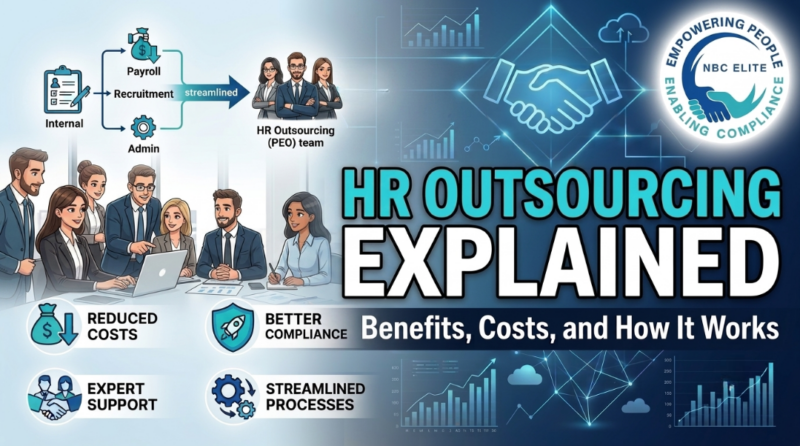
HR Outsourcing Explained: Benefits, Costs, and How It Works
Why Businesses Are Turning to HR Outsourcing
The modern-day management of human resources is a complicated exercise for businesses. There are many HR functions that require the investment of time, knowledge, and constant supervision in activities like recruiting and hiring, paying employees, dealing with compliance aspects, providing employee perks, managing performance, and creating policies.
Having workable HR department staff in place is a costly burden for companies, especially for small firms, young start-ups, and growing enterprises. This is where HR outsourcing has come into its own as an impressive solution.
With the help of HR outsourcing, companies hire external specialists for fulfilling individual HR functions assigned to these professionals who effectively perform their tasks while companies focus on their business processes and growth.
It doesn’t matter if you are a small firm trying to cut down on administrative activities or a developing enterprise that aims at compliance; comprehending the logic behind HR outsourcing will simplify managing a workforce for any corporate manager.
In this comprehensive guide, we will explain:
- What HR outsourcing is
- How HR outsourcing works
- Different types of HR outsourcing services
- Benefits of outsourcing HR functions
- HR outsourcing costs and pricing models
- Advantages and disadvantages
- How to choose the right HR outsourcing provider
- Future trends in outsourced HR management
What Is HR Outsourcing?
HR outsourcing is the process of transferring duties and responsibilities to an HR service provider or a company specializing in a specific HR function.
They outsource all HR-related functions to specialized companies with trained HR professionals, HR software, HR compliance understanding, and workforce management expertise.
An HR outsourcing company could handle the following services:
- Payroll processing
- Employee benefits administration
- Recruitment and hiring
- Employee onboarding
- HR compliance
- Tax administration
- Training and development
- Performance management
- Employee relations
- HR technology management
The objective of HR outsourcing is to enhance the effectiveness, cut down expenses, lower risk and improve HR assistance for employees.
How Does HR Outsourcing Work?
Typically HR outsourcing occurs in several key steps:
1. Business Needs Assessment
The first step is to determine which HR functions should be outsourced.
A company may outsource:
- Only payroll management
- Recruitment services
- Employee benefits administration
- Compliance management
- Complete HR operations
The outsourcing provider assesses the size of the organization, industry, employee needs, and existing HR problems.
2. Selecting an HR Outsourcing Partner
When businesses look into HR outsourcing service providers they look at the following factors:
- Industry experience
- Service offerings
- Technology solutions
- Pricing structure
- Customer reviews
- Compliance expertise
- Data security practices
It is important to pick the right HR partner, since they deal with sensitive employee data.
3. Service Agreement and Implementation
Once they have chosen a provider, both parties will draw up a contract of services which specifies:
- Responsibilities of the outsourcing provider
- Services included
- Pricing terms
- Data protection requirements
- Performance expectations
- Communication processes
The provider then connects its HR systems to the company’s processes.
4. HR Operations Management
After they are put in place, the outsourcing partner oversees the HR tasks agreed upon.
Examples include:
- Processing employee salaries
- Managing benefits enrollment
- Handling employment documentation
- Supporting recruitment campaigns
- Monitoring labor law compliance
- Providing HR reports and analytics
5. Continuous Support and Improvement
An experienced HR outsourcing firm regularly assesses performance and works on process improvement using the following:
- Regular reporting
- Technology upgrades
- Compliance updates
- Employee feedback
- Process optimization
Types of HR Outsourcing Services
HR outsourcing isn’t just a single service. There are various HR functions which can be outsourced as per the requirement of the business.
1. Payroll Outsourcing
One of the most popular HR outsourcing services is payroll.
Payroll outsourcing includes:
- Salary calculations
- Tax deductions
- Employee payments
- Payroll reporting
- Compliance management
- Payroll record maintenance
Benefits:
- Reduces payroll errors
- Saves administrative time
- Ensures compliance
- Improves payment accuracy
2. Recruitment Process Outsourcing (RPO)
In recruitment process outsourcing, organizations can let qualified hiring experts take over their recruiting jobs.
RPO providers manage:
- Job advertising
- Candidate sourcing
- Resume screening
- Interviews
- Background checks
- Hiring coordination
This is especially useful for companies experiencing rapid growth.
3. Professional Employer Organization (PEO)
A Professional Employer Organization enters into a co-employment relationship with a business.
The PEO manages:
- Payroll
- Employee benefits
- HR compliance
- Employment administration
The business remains responsible for day to day employee activities and the PEO is responsible for administrative HR activities.
4. HR Technology Outsourcing
There are some businesses that are outsourcing HR management of the technology.
Services may include:
- HR software implementation
- Employee portals
- HR automation
- Data management
- Reporting systems
This enables organizations to gain access to advanced HR tools without the need of developing an expensive internal system.
5. Benefits Administration Outsourcing
As businesses expand, employee benefits management can get complicated.
Benefits services that are outsourced could encompass:
- Health insurance administration
- Retirement plans
- Leave management
- Employee benefit communication
- Enrollment support
6. Compliance Outsourcing
Employment law and policy is often subject to ongoing changes.
HR compliance outsourcing supports businesses to deal with:
- Labor law requirements
- Workplace policies
- Employment documentation
- Regulatory reporting
- Risk management
Benefits of HR Outsourcing
1. Reduces HR Costs
One major benefit of utilizing HR outsourcing services is that companies can save on expenses.
An internal HR department entails the following costs:
- HR salaries
- Training expenses
- HR software investments
- Compliance specialists
- Administrative resources
By outsourcing HR, businesses can benefit from HR services without having to create their own internal team.
2. Saves Time and Improves Productivity
HR management can be a time-consuming task that takes a lot of effort.
Outsourcing of administrative work allows business leaders to focus on the following:
- Business growth
- Innovation
- Customer relationships
- Strategic planning
3. Provides HR Expertise
Professional HR outsourcing providers who have knowledge in:
- Employment regulations
- Payroll systems
- Recruitment strategies
- Employee relations
- HR technology
Businesses have access to skills that they may not be able to develop in-house themselves.
4. Improves Compliance Management
Errors with employment compliance may result in:
- Legal penalties
- Financial losses
- Employee disputes
- Reputation damage
HR outsourcing providers help businesses to keep their companies updated with changes in regulations and minimize risks of noncompliance.
5. Enhances Employee Experience
Effective HR system improves the level of employee satisfaction.
Outsourced HR teams can provide:
- Faster employee support
- Better onboarding experiences
- Efficient benefits management
- Professional HR communication
6. Access to Advanced Technology
Numerous HR outsourcing providers offer modern HR systems, which feature:
- Employee self-service portals
- Automated payroll systems
- Analytics dashboards
- Digital document management
- Workforce tracking tools
Businesses have access to technology without much investment.
7. Supports Business Growth
As a company grows, it has more HR needs.
Outsource HR services provide organizations with solutions:
- Hire employees faster
- Enter new markets
- Manage larger teams
- Maintain compliance
HR Outsourcing Costs: How Much Does It Cost?
The costs of HR outsourcing depend on the following factors:
- Company size
- Number of employees
- Services required
- Provider experience
- Technology requirements
- Industry regulations
There are several common models of pricing:
1. Per Employee Per Month (PEPM)
There are many HR outsourcing firms that have a certain fee per employee, per month.
Typical services may include:
- Payroll processing
- Benefits administration
- HR support
This model is widely used, as the number of workers determines cost.
2. Percentage of Payroll Model
Some providers may take a percentage of the payroll bill.
This model is suitable for the following applications:
- Payroll outsourcing
- PEO services
3. Flat Monthly Fee
Companies can get a flat fee for certain HR functions each month.
This is a good choice for businesses with consistent spending needs.
4. Custom Pricing
Bigger companies may be given a special rate depending on:
- Global workforce needs
- Multiple HR services
- Complex compliance requirements
Factors That Influence HR Outsourcing Costs
The price is influenced by a number of factors:
Number of Employees
The larger the workforce the more HR support will be required, and possibly may be able to be appointed volume discounts.
Services Required
The process of outsourcing payroll functions is less costly than outsourcing the whole HR function.
Industry Requirements
Some regulated industries might need specific compliance assistance.
Technology Requirements
The more sophisticated HR software solutions can cost more.
Geographic Location
Labour law and HR complexity differs from region to region.
Advantages and Disadvantages of HR Outsourcing
Advantages of HR Outsourcing
Cost Efficiency
It reduces HR operating costs for businesses.
Professional Expertise
Businesses have access to seasoned HR experts.
Better Compliance
External specialists help manage regulatory requirements.
Increased Focus on Core Business
This frees up managers’ time for administrative tasks.
Improved HR Processes
Outsourcing providers can provide established systems and processes.
Disadvantages of HR Outsourcing
Less Direct Control
Companies may have reduced control over some HR processes.
Data Security Concerns
HR service providers deal with delicate employee details.
Communication Challenges
If there are issues with communication, it can affect how well the services are delivered.
Dependence on External Providers
Businesses may find themselves depending on outside vendors for assistance.
Cultural Differences
External providers may not be capable of comprehending the essence of company culture.
HR Outsourcing vs In-House HR: Which Is Better?
The selection depends on requirements of businesses.
In-House HR May Be Better For:
- Large organizations with complex cultures
- Businesses that require daily HR involvement.
- Businesses with specialized workforce strategies
HR Outsourcing May Be Better For:
- Small businesses
- Startups
- Growing companies
- Organizations seeking cost savings
- Companies lacking HR expertise
A lot of businesses prefer to adopt a hybrid model where their strategic HR functions remain in-house while they work with outsourced providers and other firms to complete the needed administrative tasks.
How to Choose the Right HR Outsourcing Company
One vital consideration is figuring out which provider is most suited to your needs.
1. Identify Your HR Needs
Start by outlining exactly the responsibilities that you need to outsource.
Ask:
- Which HR tasks consume the most time?
- Where do compliance risks exist?
- What processes do you need to be improved?
2. Review Provider Experience
Look for providers with:
- Industry experience
- Strong client history
- Qualified HR professionals
- Proven processes
3. Evaluate Technology
A good HR outsourcing partner should offer:
- Secure systems
- Easy employee access
- Reporting capabilities
- Automation features
4. Check Security Practices
HR data contains personal information.
Ensure that providers employ robust security protocols.
5. Compare Pricing and Contracts
Review:
- Service fees
- Contract terms
- Additional charges
- Support availability
Common HR Outsourcing Mistakes to Avoid
Choosing Based Only on Price
The lowest-priced provider isn’t necessarily the highest quality.
Outsourcing Without Clear Goals
Organizations need to clarify their objectivesbefore outsourcing.
Ignoring Data Security
Employees’ information should be well protected.
Poor Communication
For successful outsourcing, regular communication is required.
Not Reviewing Performance
Businesses need to periodically monitor the quality of services.
Future Trends in HR Outsourcing
The HR outsourcing industry continues to develop alongside technology and changing needs in the workplace.
Artificial Intelligence in HR
AI is improving:
- Candidate screening
- Employee support
- HR analytics
- Workforce predictions
Automation of HR Processes
More companies are automating:
- Payroll
- Documentation
- Employee requests
- Reporting
Global HR Outsourcing
The rise of remote work has resulted in the increasing need for global HR platforms that assist companies employ staff globally.
Data-Driven HR Decisions
HR providers increasingly use analytics to improve:
- Hiring decisions
- Employee retention
- Workforce planning
Is HR Outsourcing Right for Your Business?
HR outsourcing may be a valuable solution for companies that desire professional HR assistance that doesn’t include the cost and complexity of dealing with all of it in-house.
It can help businesses:
- Reduce expenses
- Improve compliance
- Save time
- Access HR expertise
- Improve employee experiences
- Scale efficiently
Still, success requires working with a suitable provider and establishing clear expectations.
Conclusion
HR outsourcing is much beyond a way to save costs; it is a tactic that has grown into a promising business solution that allows firms to create healthy workplace, manage staff properly and focus on future development.
With (HR) outsourcing services ranging from payroll to hiring, legality and even full HR outsourcing, partnering with an HR provider may dramatically change the firm’s approach to managing its staff.
HR outsourcing will continue to be a valuable solution for organizations looking to develop efficient and modern business processes, since it can cope with the latest trends in employment sphere, advanced technologies and the competition in the world.
Ready to Optimize Your HR Operations?
Contact Us Today
FAQs
1. What is HR outsourcing?
HR outsourcing entails outsourcing duties related to human resource, such as payroll processing, recruitment, employee benefits, compliance and HR administration, to an outside HR service provider. It makes professional HR skills available to the business and decreases the workload and costs of businesses.
2. How does HR outsourcing work?
HR outsourcing involves delegating specific HR tasks to an external expert. Services, The services and responsibilities, pricing and communication processes are agreed between the company and the HR outsourcing partner. The provider then conducts agreed HR processes using its skill and technology.
3. What services are included in HR outsourcing?
HR outsourcing services may include:
- Payroll processing
- Employee onboarding
- Recruitment support
- Benefits administration
- HR compliance management
- Employee documentation
- Performance management
- HR software solutions
- Workforce reporting
4. What are the benefits of HR outsourcing?
The major benefits of HR outsourcing include:
- Reduced HR operating costs
- Access to HR specialists
- Improved compliance management
- Time savings
- Better employee experience
- Advanced HR technology access
- Easier business scaling
5. How much does HR outsourcing cost?
HR outsourcing costs depend on the company size, number of workers, services needed and also on the pricing structure of the HR outsourcing company. Some of the typical pricing structures are per employee per month, percentage of payroll, per month fixed fee, or a custom fee.
6. Is HR outsourcing suitable for small businesses?
Yes, HR outsourcing for small businesses can be particularly advantageous as it helps them obtain HR solutions from professionals without the necessity of having a dedicated HR staff. It simplifies processes like payroll, adherence, enrollment, and employee assistance for small businesses.
7. What is the difference between HR outsourcing and HR consulting?
HR outsourcing includes provisions of current needs of HR management to an outsourcing company, while HR consulting provides the best recommendations related to HR processes and policies.
8. What HR functions can be outsourced?
Businesses can outsource almost any HR function, including:
- Payroll management
- Recruitment
- Employee benefits
- Compliance
- Training programs
- HR administration
- Workforce management
- Employee relations support
9. Does HR outsourcing improve compliance?
Yes, HR outsourcing providers assist businesses in staying compliant by keeping an eye on the regulations related to staff, documenting the process, managing payroll procedures, and avoiding legal troubles.
10. What are the disadvantages of HR outsourcing?
Potential disadvantages of HR outsourcing include:
- Reduced direct control over some HR processes
- Data privacy concerns
- Dependence on external providers
- Communication challenges
- Need for careful provider selection
11. How do I choose the right HR outsourcing provider?
To choose the right HR outsourcing company, consider:
- Industry experience
- Service quality
- Technology platforms
- Data security practices
- Customer reviews
- Pricing transparency
- Customer support
12. Can HR outsourcing help companies grow faster?
Yes, HR outsourcing helps a company grow since it minimizes the burden of administration and provides better recruitment processes and ensures compliance allowing executives concentrate on important functions of a business.
13. What is payroll outsourcing in HR?
Payroll outsourcing refers to an external company that provides payroll services that include payroll management, payroll calculation, and payroll compliance.
14. What is PEO in HR outsourcing?
Professional Employer Organization (PEO) is an HR outsourcing solution where a provider acts as a co-employer with a company. PEOs generally take care of a range of things such as payroll, benefits, and compliance assistance.
15. Is outsource HR better than having an in-house HR department?
This will depend on the requirements of the business. In the case of small and medium sized businesses, outsourcing HR services can be advantageous because they can get expert services at a lesser expense; while for large businesses, it is possible to hire internal HR staff and external Human Resource outsourcing providers simultaneously.